

23 Jul What HR Must Do After a Truck Driver Gets Hurt
A truck driver injury rarely happens near the HR office. It happens on an interstate shoulder, at a loading dock, or at a client site miles from the main terminal, and when it does, the clock starts immediately.
Why Truck Driver Injuries Create a Distinct HR Challenge
The Incident Location is Beyond Your Control
Route-based incidents frequently occur in environments controlled entirely by third parties: law enforcement, emergency medical services, warehouse receivers, or independent tow operators. Recent highway incidents in Southern Nevada illustrate just how quickly an off-site event can become a complex workers’ compensation emergency.
When a commercial vehicle incident occurs on high-traffic routes like I-15 or near the Nevada-California border, local emergency response and highway patrol units take immediate control of the scene. This means critical physical evidence can disappear rapidly. Cargo is moved to clear roadways, damaged trucks are towed to remote yards, and digital routing messages can be overwritten by dispatch software before safety teams can archive them.
Because HR cannot rely on an injured employee stopping by the office to fill out paperwork, understanding how to report an injury while working as a truck driver in Las Vegas requires mobile-friendly intake methods and direct, real-time communication protocols with the personnel on the ground.
The Statistical Reality Demands a Formal Process
The statistical reality of commercial transportation work makes a strong case for a specialized HR playbook. Heavy and tractor-trailer truck drivers routinely experience one of the highest rates of job-related injuries across the private industry sector, translating to an incidence rate of 259.7 per 10,000 full-time equivalent workers. These injuries tend to be severe; back injuries alone account for more than 34% of all work-related musculoskeletal disorders within this worker cohort.
Beyond nonfatal strains and sprains, highway collisions present a complex challenge for safety, legal, and compliance managers. National data indicate that over 5,300 people die in large truck crashes annually, with truck occupants accounting for approximately 17% of those fatalities. Furthermore, commercial driver injuries from large-truck crashes average over 161,000 cases per year, with driver fatigue, distracted driving, and sudden mechanical failures cited as leading causes. Equipping dispatch and HR teams with an actionable digital response plan minimizes post-incident chaos and ensures the driver receives prompt medical attention.
| Injury Response Factor | Office-Based Employee Injury | Truck Driver / Route-Based Injury |
| Location of Incident | Employer premises | Highway, dock, customer site, yard, out of state |
| Access to Witnesses | Usually immediate | Often dispersed or independent third parties |
| Reporting Path | Supervisor or HR nearby | Driver, dispatch, safety, fleet manager, HR |
| Evidence Preservation | Local CCTV, internal witnesses | ELD data, route records, vehicle photos, bills of lading |
| Form Completion | In-office | Remote, mobile-first, highly time-sensitive |
| Return-to-Work | Centralized office adjustments | Requires route/duty review and dispatch coordination |
The First 24 Hours: A Step-by-Step HR Checklist
1. Stabilize the Employee and Confirm Emergency Care
When an incident occurs on the road, the employer’s immediate priority must be the worker’s physical safety and medical stability—not the cargo, the route, or the vehicle. Dispatchers and HR personnel must work in tandem to execute a structured first-day response:
- Assess Emergency Needs: If the injury involves a vehicle crash, head trauma, severe burns, uncontrolled bleeding, or chest pain, immediately ensure 911 has been contacted.
- Halt the Route: Explicitly instruct the driver not to continue the delivery, as doing so could worsen the injury and create severe liability risks.
- Establish the Work Connection: Direct the employee to identify the injury as work-related to the attending medical staff so that early medical records clearly document the connection between the treatment and their duties.
- Notify Internal Stakeholders: Alert HR, dispatch, safety directors, and risk personnel simultaneously.
- Initiate a Time-Stamped Log: Record who learned what, when, and from whom, updating it continuously as new information arrives.
- Preserve Data Immediately: Archive Electronic Logging Device (ELD) data, dispatch messages, Driver Vehicle Inspection Reports (DVIRs), and customer delivery records before they are systematically overwritten.
2. Separate Emergency Response From Claim Administration
Helping an employee secure an ambulance or coordinate a heavy-duty tow truck is not the same operational function as completing the formal workers’ compensation process. Conflating the two is a common administrative mistake.
Important Compliance Note: External emergency personnel focus solely on physical stabilization and public safety; they do not handle employer paperwork. Even if a major collision on a route like I-215 generates public police reports and third-party warehouse logs, the trucking employer must independently verify, document, and report the event to their insurer.
3. Secure Written Notice to Meet State Deadlines
Nevada law imposes strict timelines for notifying an employer about an occupational injury or illness. Under NRS 616C.015, an injured employee must provide written notice of a work injury to the employer as soon as practicable, but no later than 7 days after the accident.
For HR, the operational goal is to secure this written notice on the same day whenever possible, leveraging secure emails, text messages, or specialized mobile HR software if the worker is remote. This notice must capture the date, time, location, truck/trailer numbers, specific route, task being performed, and witness names.
4. Differentiate and Track Nevada Workers’ Comp Forms
Navigating state-specific paperwork is a cornerstone of transportation compliance. HR must clearly distinguish between the two key documents:
- Nevada C-1 Form (Notice of Injury): Completed by the employee to formally document that the employer was notified of the event.
- Nevada C-4 Form (Claim for Compensation): Completed by the employee and the attending medical provider. Under NRS 616C.135, this formal claim must be filed within 90 days of the accident.
Once the C-4 form is submitted, the insurer has 30 days to formally accept or deny the claim under NRS 616C.065, making rapid processing essential.
5. Provide Plain-Language Instructions
Injured commercial drivers are frequently dealing with severe physical pain, stress, and the immediate logistics of managing law enforcement inquiries or towing operators. HR should avoid handing them a dense packet of legal jargon. Provide short, mobile-accessible instructions that cover exactly who to notify, where to seek approved medical care, and how to submit forms on the road to protect their claim eligibility.
What HR Must Preserve Before the Record Goes Cold
Route-Based Evidence Disappears Fast
Unlike a controlled corporate facility, where an incident scene can be taped off, route-based delivery sites and highway corridors reset at remarkable speed. Third-party warehouse managers quickly clear loading docks, cross-dock freight onto alternate trailers, and move truck cabs for mechanical repair to minimize operational downtime.
Furthermore, electronic records tied to the trip—including dispatch communications, telematics data, and GPS pings—may be automatically overwritten by fleet management software within days or even hours if not manually pulled.
The Essential Document Checklist
HR personnel must systematically gather and archive the following operational documents to build a defensible incident file:
- All dispatch text sequences and proprietary mobile app communication logs
- Hours-of-Service (HOS) logs detailing the driver’s full duty cycle
- GPS, speed, and telematics data exports
- Bills of lading, customer delivery paperwork, and any incident reports filed by the receiving facility
Why Fatigue and Scheduling Records Matter
Commercial driver fatigue remains a heavily scrutinized element in post-accident investigations, making scheduling records highly relevant to the overall workers’ compensation file. Under 49 C.F.R. Part 395, the Federal Motor Carrier Safety Administration (FMCSA) imposes non-negotiable HOS regulations.
ELD records become material evidence the moment fatigue or schedule pressure is raised as a contributing factor in a collision or loading dock incident. Securing these records protects the organization during multi-party investigations and provides the necessary context for any resulting third-party liability claims.
Aligning HR, Dispatch, and Operations
Create a Single Source of Truth
Transportation incidents inherently involve a complex web of internal and external stakeholders (HR, dispatch, safety officers, claims adjusters, and medical personnel). Managing this information flow requires strict communication protocols to ensure no party acts on outdated assumptions.
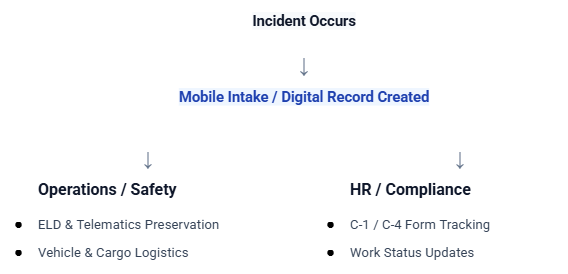
To prevent disjointed communication, employers should establish a centralized, shared digital incident record. A unified digital approach ensures that the safety manager reviewing telematics data and the HR partner tracking medical notes are working from the exact same factual foundation.
Watch for Common First-Day Mistakes
Even experienced HR departments stumble over preventable administrative errors during the critical first 24 hours. The most common errors include:
- Assuming a frantic phone call from a driver to a dispatcher satisfies legal reporting requirements.
- Failing to secure formal written notice within the statutory window.
- Confusing the regulatory purposes of the C-1 and C-4 forms.
- Neglecting to document the specific work task the driver was performing at the precise time of injury.
Proactive Infrastructure Protects the Bottom Line
When commercial drivers perform their duties on interstate highways, in busy equipment yards, and at remote customer locations, HR needs a response process built for distance, mobility, and speed. Implementing a mobile-friendly injury reporting framework before an emergency strikes allows your organization to capture volatile evidence, streamline communication, and quickly coordinate medical resources.
By bridging the operational gap between the driver’s cab and the corporate office through centralized digital workflows, transportation companies can safeguard their workforce, protect their bottom line, and maintain total compliance no matter where the next shift leads.
No Comments