

22 Oct Best HR and Payroll Solutions to Consider in 2026
Payroll and HR administration eat time that small and mid-sized businesses simply don’t have. Pick the wrong platform and you’re looking at missed tax deadlines, compliance gaps, and frustrated employees, none of which are cheap to fix. The best HR and payroll platforms to consider in 2026 differ by business size, industry, and how much hands-on support a team actually needs.
What Payroll Software Really Does (and Why It Matters More in 2026)
Payroll software automates the calculation, filing, and distribution of employee compensation, and the good platforms go well beyond cutting checks. Tax law changes, multi-state employee situations, and tightening labor compliance requirements have made manual payroll genuinely risky; according to IRS data cited on HR platforms, roughly one-third of businesses pay payroll penalties at some point.
Modern platforms now handle direct deposit, W-2 and 1099 processing, garnishments, hiring and training, benefits administration, and time tracking from a single dashboard. Some add PEO (Professional Employer Organization) services, which let a provider share the legal employer relationship and shoulder part of the compliance burden. That distinction matters. A full-service PEO is meaningfully different from payroll-processing software alone, and buyers should know which one their shortlist actually offers.
1. Hybrid Payroll
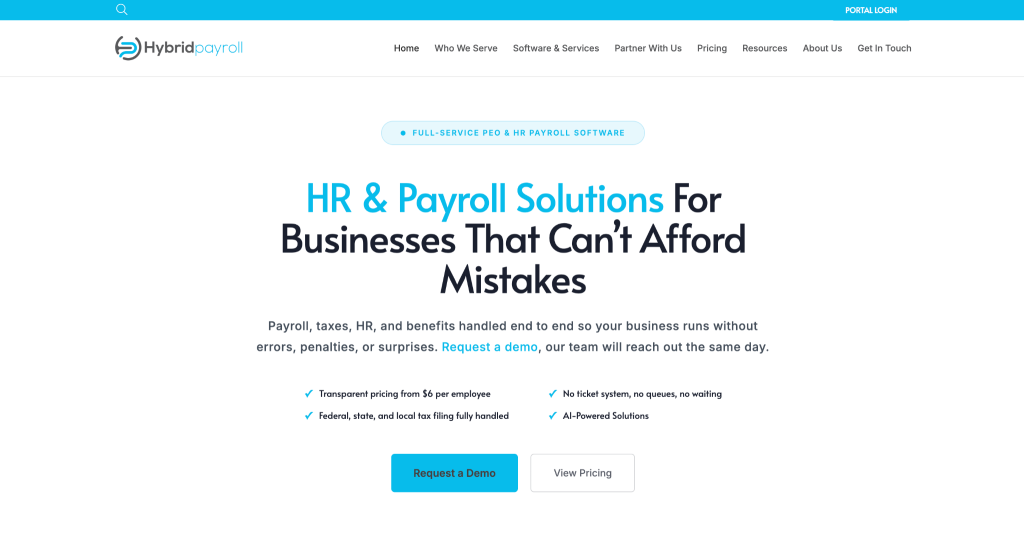
A Colorado-based payroll and PEO platform built on iSolved HCM, Hybrid Payroll combines software automation with a dedicated payroll specialist for each client: an unusual model for a provider targeting businesses in the 10-to-500-employee range.
Teams that want both technology and an actual human on their account can look at what https://hybridpayroll.com/ covers, particularly for industries such as cannabis, retail, manufacturing, and construction where compliance demands are specific. Hybrid Essential starts at $6 per employee per week; Hybrid PEO starts at $17 per employee per week; HR tiers range from $2.50 to $25 per employee depending on service level. Typical setup runs two to four weeks and includes data migration, parallel payroll runs, and staff training; each client gets a dedicated specialist with a stated 24-business-hour response time.
- Standout capability: Purpose-built cannabis payroll compliance, including automated Section 280E tax handling and cannabis-friendly banking coordination, developed when most mainstream providers refused to serve the industry
- Platform features: Workforce scheduling, Attract & Hire applicant tracking (posting to 4,000+ job boards), time and attendance, performance management, learning management, and predictive analytics as modular add-ons
2. Paychex
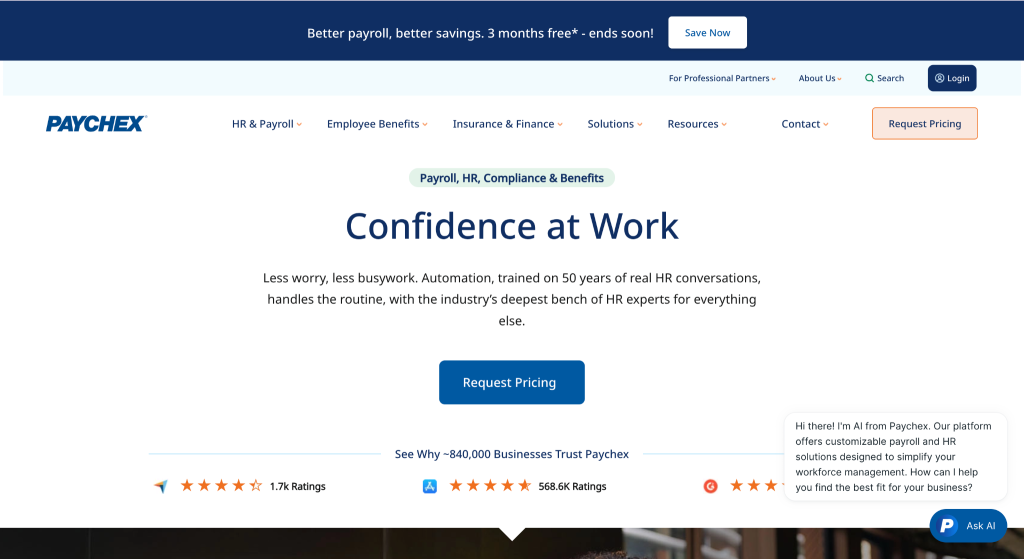
Paychex is one of the largest HR and payroll providers in the U.S., serving approximately 800,000 payroll clients and paying 1 in 11 U.S. private-sector workers through its HCM platform, Paychex Flex®.
Paychex has more than 100 offices nationwide, roughly 19,000 employees, and $5.2 billion in revenue in 2024, and is ranked 681st on the Fortune 500. The breadth of services suits businesses that want an established, nationally recognized provider, but the platform’s size may mean less personalized account handling than smaller competitors offer.
- Standout capability: Largest 401(k) recordkeeper in the U.S. by PLANSPONSOR magazine for ten consecutive years, covering more than 90,000 plans, a meaningful differentiator for businesses prioritizing retirement benefits
- Platform features: Payroll, HCM, HR management, talent acquisition, workforce management, business insurance, and employee benefits all available within Paychex Flex®
3. Gusto
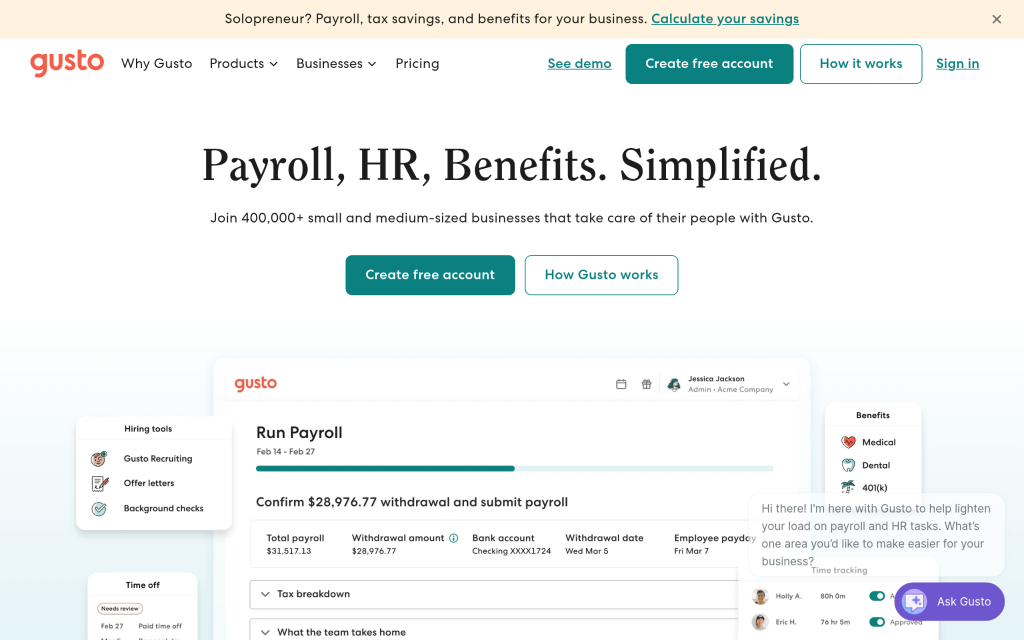
Gusto is a San Francisco-based payroll and HR platform serving 400,000 U.S. businesses, known for including automatic tax filing with every payroll run at no extra charge: something many competitors bill separately.
Tax filing is bundled in, not an add-on, and the platform integrates with nearly 150 third-party software products. Gusto’s 4,008-person team skews toward product and engineering, which shows in the interface, making it a strong fit for businesses in accounting, retail, tech, and professional services looking for a clean, software-first experience.
- Standout capability: Automatic filing with the correct federal and state agencies on every payroll run; custom setup checklists and applicant tracking built into the platform
- Platform features: Payroll processing, health and dental and vision insurance enrollment, 401(k) administration (via third parties), workers’ compensation, time tracking, and job tracking
4. Paycor
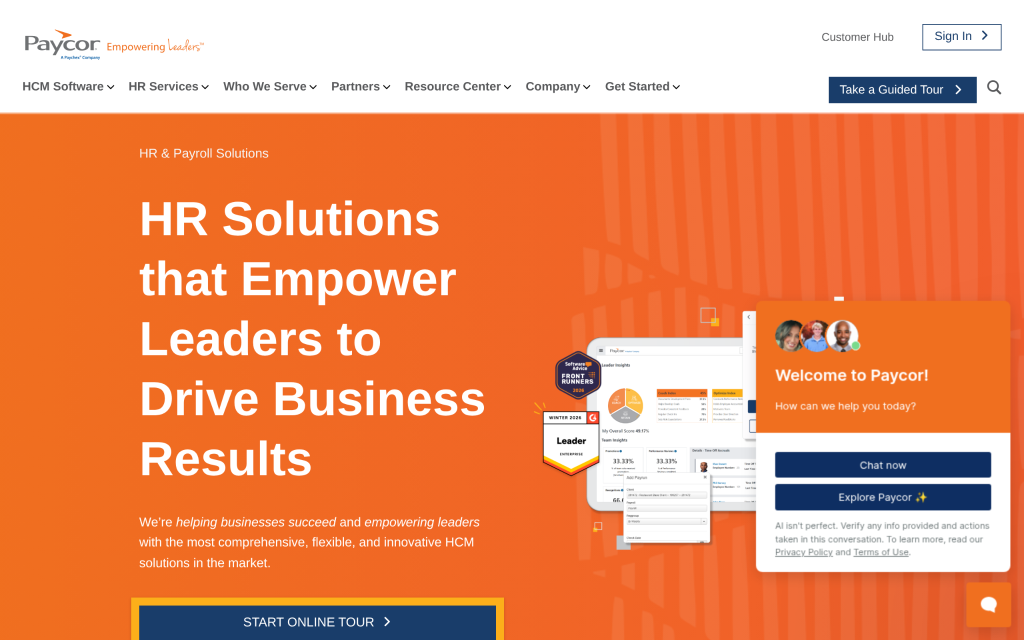
Paycor is a Cincinnati-based HCM platform founded in 1990, focused on the needs of organizational leaders rather than HR generalists, with more than 30,000 customers and 2 million supported employees across all 50 states.
Paycor uses a subscription-based SaaS model; pricing is not publicly listed but follows a per-employee structure. Customers consistently cite Paycor’s partnership-driven service approach; the platform targets businesses that want strategic HR tools, not just payroll processing, so buyers who need only simple payroll may pay for features they won’t use.
- Standout capability: A unified platform covering recruiting, hiring and training, payroll, career development, and retention, with powerful analytics and configurable industry-specific settings for healthcare, retail, manufacturing, and hospitality
- Platform features: Hiring and training, time-keeping, payroll, HR management, talent development tools, and third-party app integrations
5. BambooHR
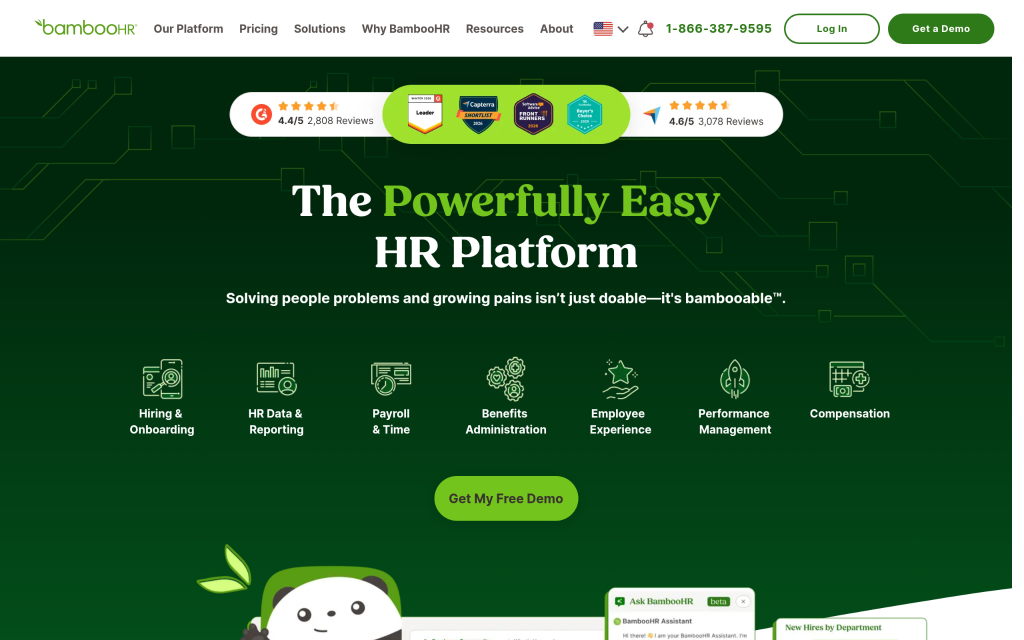
BambooHR is a Utah-based HR software platform founded in 2008, serving more than 34,000 customers and 3 million employees, with a platform that spans the entire employee lifecycle from applicant tracking through exit workflows.
BambooHR has approximately 1,700 employees across multiple continents and a strong customer base across North America and internationally.
- Standout capability: An HR assistant, salary benchmarking data inside compensation planning, and eNPS employee satisfaction surveys, built-in tools that go beyond standard payroll
- Platform features: Applicant tracking, hiring and training workflows, employee records, paid time off management, full-service payroll with tax filing, benefits administration, performance management, time tracking, reporting and analytics, e-signatures, and mobile applications
- Worth noting: BambooHR’s strength is people management and HR data rather than payroll depth; businesses that need advanced PEO services or heavy multi-state payroll complexity may find it lighter than purpose-built payroll platforms
Bottom Line
Here’s the thing, the right HR and payroll platform in 2026 isn’t the one with the longest feature list; it’s the one that fits what your business actually needs from the relationship. Gusto suits lean teams who want clean software with tax filing already baked in. Paychex is a natural fit for businesses that prize scale and retirement-plan depth. Paycor works well when leadership wants analytics and strategic HR tools bundled together. BambooHR shines brightest when people management and culture tools are the real priority.
But for businesses that want a dedicated human on their account, PEO co-employment, or cannabis-specific compliance, a full-service provider with a specialist model will serve them far better than any self-service app. So run a short list, ask each vendor what their setup timeline actually looks like, and confirm – before you sign anything – whether tax filing is included or billed separately. The catch is that many platforms bury that detail in the pricing footnotes.Payroll and HR administration eat time that small and mid-sized businesses simply don’t have. Pick the wrong platform and you’re looking at missed tax deadlines, compliance gaps, and frustrated employees, none of which are cheap to fix. The best HR and payroll platforms to consider in 2026 differ by business size, industry, and how much hands-on support a team actually needs.
No Comments